


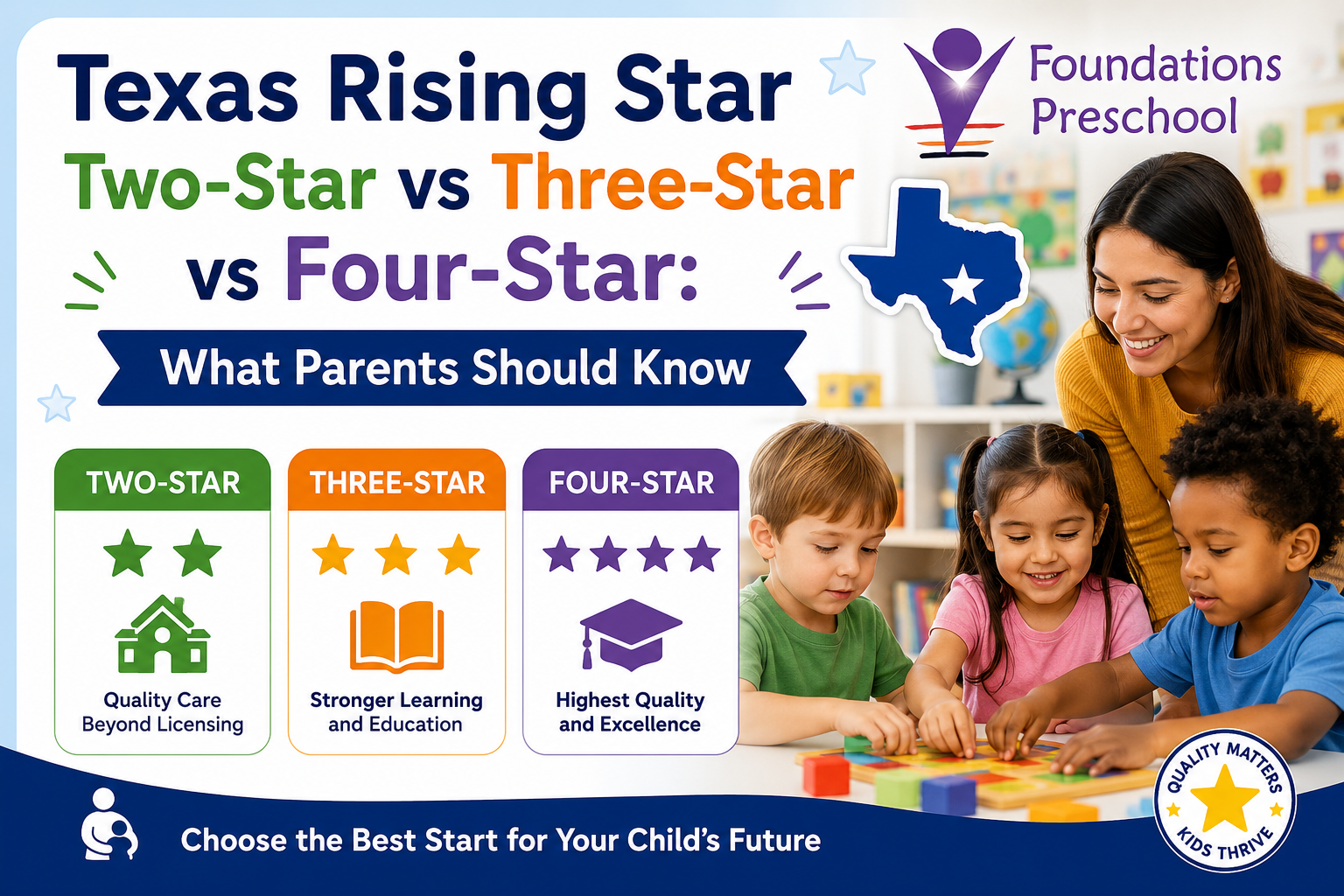
Choosing the right childcare program is one of the biggest decisions parents make. Families want a place where children can learn, stay safe, and develop social and emotional skills. In Texas, the Texas Rising Star (TRS) program helps parents identify childcare providers that meet higher standards of quality beyond basic state requirements.
However, many parents become confused when they see childcare centers labeled as Two-Star, Three-Star, or Four-Star Texas Rising Star programs. What do these ratings mean? Does a Four-Star program automatically mean it is the best choice for every child? And how much difference exists between these levels?
This guide explains the key differences between Texas Rising Star ratings and what parents should know before choosing a childcare center.
What Is Texas Rising Star?
Texas Rising Star is a quality rating and improvement system for childcare providers in Texas. The program evaluates childcare centers and early learning programs on criteria that go beyond minimum licensing requirements.
Instead of simply meeting state regulations, providers earn star levels based on factors such as:
- Teacher qualifications
- Child-teacher ratios
- Learning environments
- Curriculum quality
- Parent communication
- Staff training
- Child development practices
The goal is to help parents easily identify programs that provide stronger educational and developmental support.
A higher star level generally indicates a higher level of quality and commitment to early childhood education.
Understanding Texas Rising Star Levels
Texas Rising Star providers are typically evaluated and awarded one of three quality levels:
- Two-Star
- Three-Star
- Four-Star
Each level reflects how well a childcare program performs in important areas.
Let’s examine them individually.
Two-Star Texas Rising Star Programs
A Two-Star Texas Rising Star childcare center has met quality standards that exceed basic licensing requirements.
These programs usually provide:
- Improved classroom environments
- Better teacher-child interaction
- Basic educational activities
- Additional staff training
- Enhanced safety and developmental practices
Two-Star providers are often a good option for parents seeking affordable childcare while still obtaining quality improvements beyond minimum state standards.
Advantages of Two-Star Programs
Lower cost in some cases
Some Two-Star programs may have lower tuition rates compared to higher-rated facilities.
Improved standards
They still exceed standard licensing expectations.
Supportive environments
Children receive structured activities designed to encourage growth and learning.
Possible limitations
Two-Star programs may have:
- Less advanced curriculum planning
- Fewer highly qualified staff members
- Higher child-to-teacher ratios than higher-star facilities
For some families, however, these programs provide a strong balance between affordability and quality.
Three-Star Texas Rising Star Programs
A Three-Star Texas Rising Star provider demonstrates a stronger commitment to quality and educational excellence.
These programs typically include:
- More qualified teaching staff
- Better classroom organization
- Stronger curriculum implementation
- Enhanced child engagement activities
- Lower teacher-child ratios
Three-Star programs focus heavily on creating learning experiences that support children’s development.
Benefits of Three-Star Programs
Stronger educational structure
Children often participate in activities focused on:
- Early literacy
- Language development
- Social skills
- Problem-solving
- Creativity
Higher staff qualifications
Teachers generally receive additional training and professional development.
Improved parent communication
Parents often receive more updates about child progress and classroom activities.
Many families consider Three-Star centers an excellent middle ground between affordability and premium childcare quality.
Four-Star Texas Rising Star Programs
A Four-Star Texas Rising Star program represents the highest quality level within the Texas Rising Star system.
These providers meet rigorous standards in multiple evaluation areas.
Four-Star centers often include:
- Highly qualified educators
- Exceptional teacher-child interactions
- Strong learning environments
- Comprehensive curriculum planning
- Extensive staff training
- Individual child development support
These programs are designed to maximize children’s learning and developmental outcomes.
Benefits of Four-Star Programs
Highest educational quality
Programs often use evidence-based teaching methods that support early childhood development.
Lower teacher-to-child ratios
Children may receive more individual attention.
Highly trained staff
Teachers frequently participate in ongoing education and skill development.
Family engagement
Parents are often encouraged to participate through meetings, progress updates, and learning activities.
Things parents should consider
Although Four-Star programs provide excellent quality, they can sometimes have:
- Higher tuition costs
- Longer waiting lists
- Limited availability
The highest rating does not automatically guarantee the perfect fit for every child.
Comparing Two-Star, Three-Star, and Four-Star Programs
Below is a simplified comparison:
| Feature | Two-Star | Three-Star | Four-Star |
| Quality beyond licensing | Yes | Yes | Yes |
| Teacher qualifications | Moderate | Higher | Highest |
| Learning activities | Basic structured learning | Strong curriculum | Advanced curriculum |
| Parent communication | Moderate | Good | Extensive |
| Teacher-child ratios | Improved | Better | Best |
| Staff training | Additional training | Strong training | Extensive ongoing training |
Does a Higher Star Rating Mean Better Childcare?
Not necessarily in every situation.
While higher ratings generally indicate stronger educational practices, parents should consider additional factors such as:
Child personality
Some children thrive in smaller environments, while others enjoy larger social settings.
Location convenience
A highly rated center that requires long travel times may create stress for families.
Cost and budget
Higher-rated centers may charge more. Parents should choose a program that aligns with their financial situation.
Communication style
Parents should feel comfortable with the teachers and staff.
Cleanliness and environment
Visiting a center in person can reveal details that ratings alone cannot show.
Questions Parents Should Ask Before Choosing a Childcare Center
When visiting any Texas Rising Star provider, consider asking:
- What curriculum do you use?
- How are teachers trained?
- What is your teacher-to-child ratio?
- How do you communicate with parents?
- What safety procedures are in place?
- How do you handle behavioral concerns?
- What activities support child development?
These questions can help parents make a more informed decision.
Final Thoughts
The Texas Rising Star system makes it easier for families to identify quality childcare providers, but star ratings should be viewed as a guide rather than the only deciding factor.
A Two-Star program can provide quality care that exceeds minimum standards. A Three-Star program often offers stronger educational experiences and staff qualifications. A Four-Star program represents the highest level of quality and child development support.
The best childcare choice depends on your child’s needs, your family’s budget, and the environment where your child feels comfortable and supported.
When parents understand the differences between Texas Rising Star levels, they can make confident decisions that support their child’s early learning journey.

Leave a Reply